the half of compression nobody teaches
compression is a mirror. downward turns loud parts down. upward turns quiet parts up. most producers only ever learn one half.
a producer i know plays me a Bon Iver track and asks why the vocal sounds like the singer is whispering directly into a microphone six inches away. he wants to know which compressor Justin Vernon is using, because he loves the intimacy. i tell him: probably none of the compression he is thinking of is doing that. the intimacy is upward, not downward.
he says “what is upward compression.”
most producers spend their entire career using only downward compression and call it “compression.” it is not their fault. nearly every famous compressor, LA-2A, 1176, FabFilter Pro-C 3, the SSL bus comp, does only the downward half. the few plugins that offer the other half either bury it in a menu or get the noise problem wrong. but once you hear what upward compression does on the right material, you cannot un-hear it.
the frame
compression is a mirror operation. downward compression: signal exceeds a threshold, turn it down. upward compression: signal falls below a threshold, turn it up. they affect opposite halves of the dynamic range. one kills peaks. the other recovers detail. you need both for some material, and one isn’t a substitute for the other.
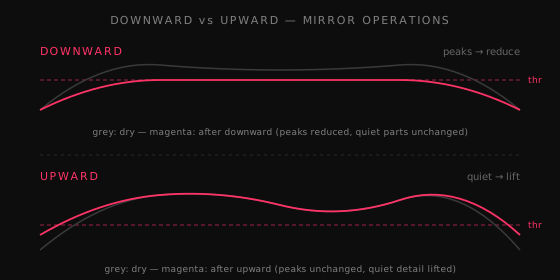
top panel: downward acts above the threshold, peaks come down, average rises with makeup gain. bottom panel: upward acts below the threshold, quiet decay rises, peaks stay where they were. the asymmetry matters. downward is the move when the loud parts are the problem. upward is the move when the quiet parts are the problem. most producers reach for the same tool for both.
what upward compression actually fixes
four problems show up over and over in mixing that downward compression can’t solve.
room tone disappears in the verse and reappears in the chorus. the dry recording has consistent room sound, but you compressed the chorus harder, and now the chorus sounds direct while the verse sounds ambient. upward compression on the chorus lifts the room back up.
piano sustain dies before the next note arrives. the attack is loud, the release tail is quiet. downward compression squashes the attack. upward compression lifts the tail. these are different fixes for different problems.
hi-hat air gets buried in dense arrangements. the 8-12 kHz region of the hat sits at the noise floor of the rest of the mix. an air-band upward boost (per-band, narrow target) brings the shimmer up without lifting any unwanted noise from elsewhere.
breath and consonant detail on intimate vocal performances. the unvoiced “h” and “f” carry far less energy than the vowel beside them, far enough that a compressor set for the syllable never sees them. compressing the syllable does not help, it just makes the syllable smaller relative to the next one. lifting the breath does. that is what makes a Bon Iver vocal sound like a Bon Iver vocal.
why upward compression is so rare
every major dynamics plugin is downward only because broadband upward compression is hard to get right. the gain has to reach further down the dynamic range than downward compression reaches up. boost a signal sitting 30 dB below the threshold by 6 dB and you also boost the noise floor underneath it (near digital silence on a clean recording, much higher on a tape transfer) by 6 dB. on a clean digital recording this is fine; on a tape transfer or a guitar amp DI, it’s brutal. the plugin has to know what is signal and what is noise, and broadband detectors can’t make that distinction.
the only version that holds up across real material is per-band upward compression. the plugin decomposes the signal into many frequency bands, runs an independent upward compressor on each band, and only lifts bands where useful detail lives. silent bands stay silent because the per-band detector doesn’t see signal there. dense bands get lifted because the detector sees something to work with. this is a different architecture from a broadband upward compressor, and it’s also why the technique is rare on plugin spec sheets, the engineering isn’t free.
what this changes
next time a quiet section of a mix feels too distant, do not reach for downward compression and a fader ride. try per-band upward compression on that section instead. listen for the room and the breath coming up while the loud parts stay where you wanted them.
start small. amount around 25-35%, one knob on whatever per-band tool you are using, a sparse drum or vocal section that has obvious quiet detail. you will hear the difference in the first 5 seconds, usually the second-best take suddenly sounds like the best take, because the breath was the thing missing.
from the studio
four issues in. the reply queue has a usable rhythm now and the next four Tuesdays are mostly drafted. one piece i am still working out is a Build-Log on the support inbox lessons from the first month of the new nurture sequence, that’s on the calendar for mid-June.
what is the first thing you reach for when a quiet section feels too distant? if it’s a fader ride, i want to hear why. those replies become next month.
jonas
more field notes
Sep 15, 2026
·sound science
your loudest master never arrives loud
streaming turns your master down to a target before anyone hears it, so mastering louder buys nothing but lost dynamics. and the loudness war mostly did not do what people think: measured across five decades the spread between loud and quiet did not narrow. what came down was the transient crack, by about a decibel and a half. so the thing to watch is heavy limiting and clipping, more than compression as an idea, and the move is to master until it is finished and let the platform set the number.
Sep 8, 2026
·sound science
the dialogue you mixed is not the dialogue they hear
a chain of reasonable decisions ends at the sofa with the voice buried. the film is about the chain. this issue is about your end of it: how to mix dialogue so it survives a stereo fold-down, a flat panel and an ordinary pair of ears, with the numbers i use, including one my own films failed on.
Sep 1, 2026
·sound science
a row of spikes nobody trained in
generated music leaves a mark, and it has nothing to do with taste. it is a row of evenly spaced spikes, put there by an operation that is also sitting inside half the plugins you own. which gives you a rule you can use on any analyzer: evenly spaced peaks came from a process, musically spaced peaks came from the music. plus a second tell the paper does not cover, and a note on why neither one is worth trying to EQ.