WARM / plugin 02
tape, tube, transformer with per-harmonic control.
tape for warmth, tube for even harmonics, transformer for asymmetric drive. each harmonic shaped independently through 7th-order Chebyshev waveshaping. not random distortion.
50 papers. 5 knobs. $29.
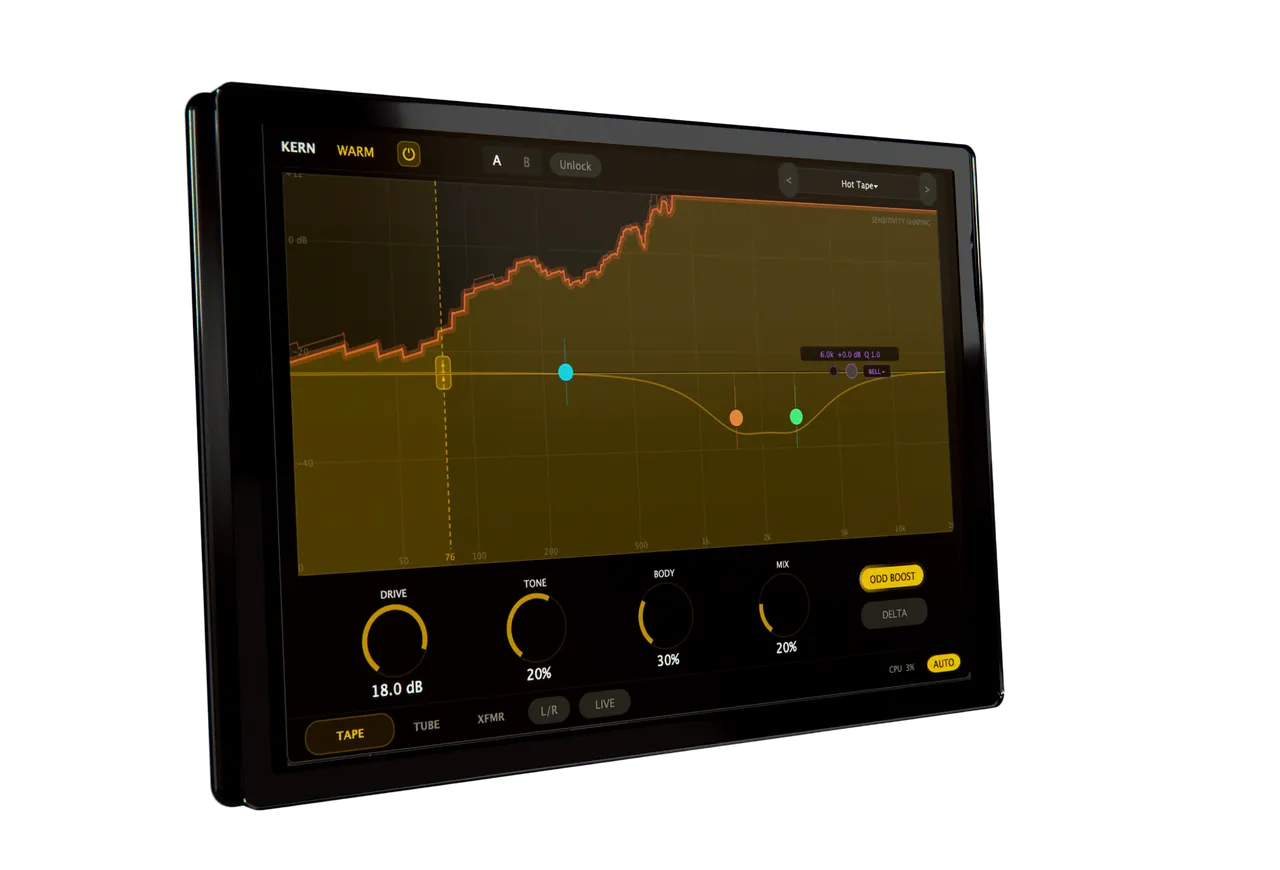
in motion
watch WARM work.
WARM added frequency-dependent spectrum smoothing, peak hold ghost line, and transient flash overlay. April 7 visual identity refresh still in place: editable EQ values, improved inline controls.
listen
hear the difference.
click play. choose original or with WARM while listening. replay from start to hear the phrase again.
🎧 for best results, listen on headphones or studio monitors.
space: play/pause. left/right or a/b: switch.
loading audio
space: play/pause. left/right or a/b: switch.
loading audio
space: play/pause. left/right or a/b: switch.
loading audio
space: play/pause. left/right or a/b: switch.
loading audio
space: play/pause. left/right or a/b: switch.
loading audio
space: play/pause. left/right or a/b: switch.
loading audio
space: play/pause. left/right or a/b: switch.
loading audio
explore the interface
see what you're hearing.
WARM in Tube mode with the Cassette Glow preset. the sensitivity shaping lets you push the low-mids harder while keeping the highs clean.
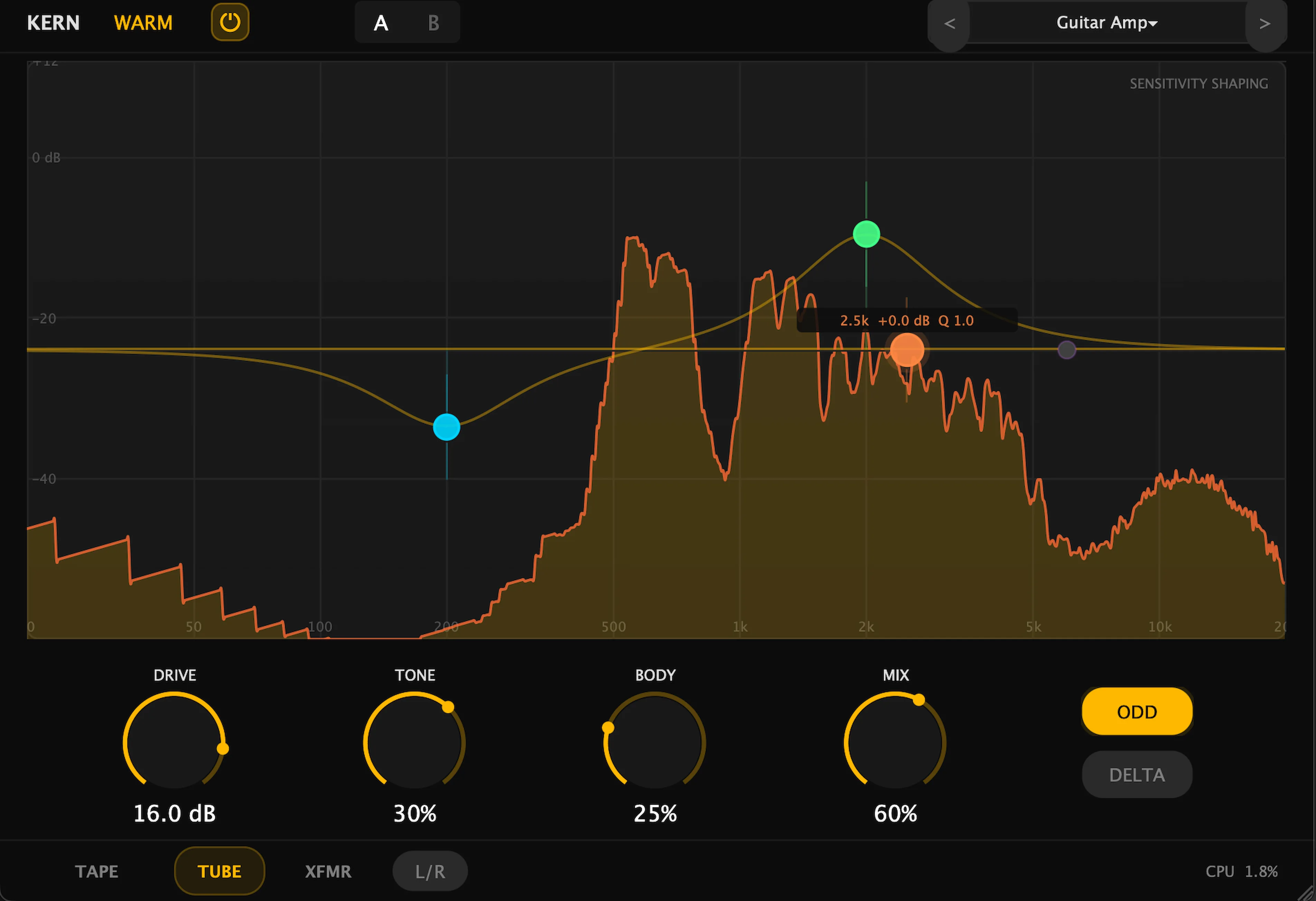
hover the numbered dots to explore the interface
features
what makes WARM different.
01 / three real characters
tape is warm and gritty. tube adds rich even harmonics. transformer goes deep with asymmetric character. they actually sound different.
02 / precise harmonic control
each harmonic is controlled independently. not random distortion. precise harmonic architecture.
03 / spectral-aware drive
per-band spectral pre-gain shapes the signal before saturation. the spectral display shows exactly what's happening.
04 / program-dependent response
an envelope follower modulates drive with input level. louder signals push harder, like real analog circuits.
under the hood
the signal path.
spectral pre-gain
STFT analysis with 40 ERB bands shapes the signal before saturation. each frequency region gets independent drive control via the spectral display.
per-character soft clipping
tape uses symmetric tanh. tube uses a bias-shifted sigmoid that naturally generates even harmonics. transformer adds a quadratic asymmetry term for deep even-harmonic richness.
Chebyshev polynomial waveshaping
7th-order Chebyshev polynomials give independent control of each harmonic. the fundamental is always protected. only harmonics 2-7 scale with drive.
antiderivative anti-aliasing
2nd-order ADAA, with 2x oversampling up to 96 kHz for ~52 dB alias rejection (ADAA alone above that, ~40 dB). bypassed at high sample rates. that is suppression rather than elimination, and it buys clean saturation without wasting CPU.
K-weighted auto-compensation
loudness-matched output using ITU-R BS.1770 weighting. the saturated signal never sounds louder than the dry. you hear the character, not the volume.
specifications
the numbers.
system requirements
learn the science
understand what WARM is doing.
free guides built from the same research behind the plugin. no paywalls, no courses to sell.
what is saturation
the physics of analog warmth and why digital recreations exist.
02tube, tape, and transformer
three analog circuits, three harmonic signatures. how they differ.
03harmonic distortion explained
even vs odd harmonics, transfer functions, and why order matters.
go deeper
full documentation.
controls, presets, how the Chebyshev waveshaping pipeline works, character guide, quick start recipes, and technical specs.
read the docsone plugin, or the whole set
one-time. yours forever. no subscription, no iLok.
all five plugins
$79
SMOOTH, WARM, WIDE, PUSH and OPEN. about $16 each. one license key.
buy one now, or all five at once. same plugins, same offline license, no subscription.
what people are saying
KERN Audio Plugin Review: SMOOTH, WARM & WIDE / Edizon
Plugin Demo Pt. 2 — KERN WARM, SMOOTH & WIDE on a full mix / Edizon
WARM by KERN Audio — Tape, Tube & Transformer Saturation / satyatunes