your compressor inherits everything upstream
Mathieu sent a session asking why his bus comp sounded mushy. the answer was three plugins earlier in the chain. four jobs that come first.
a producer named Mathieu sent me a session last week. he had a vocal track that needed compression. he loaded a 4:1 compressor at -18 dB threshold, attack 5 ms, release 100 ms. the vocal still sounded wrong. he swapped to a different compressor. then a different preset. then a different plugin from another company. an hour later he had learned nothing about the vocal and was about to blame compression for not solving a problem compression cannot solve.
his vocal had a 3.4 kHz sibilance peak, a phase issue between two double tracks, and a 280 Hz body resonance nobody had touched. the compressor was not failing. it was being triggered by content he had not addressed yet. and once a compressor is triggered by the wrong material, no amount of attack-and-release tuning fixes the underlying problem.
the frame
the compressor inherits whatever you didn’t fix upstream. compression is a dynamic-range tool. it does not fix tone, resonance, stereo image, or harmonic content. those are different categories of work that have to happen first, or the compressor inherits them.
four jobs come before compression on almost every track in almost every genre.
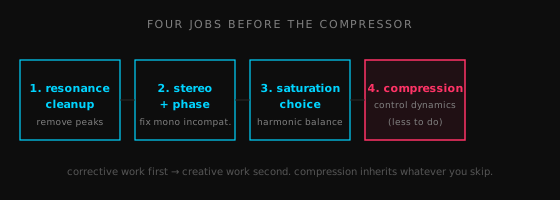
resonance cleanup, stereo and phase, saturation, then compression. the diagram looks obvious until you watch how often producers skip the first three and reach for a compressor anyway.
job 1: resonance cleanup
a vocal recorded in a small room has a 200 Hz boxiness. a steel-string acoustic has an 800 Hz body resonance. a bright synth has harshness at 3-4 kHz. these are constants in the performance, not dynamic events. when the resonance hits the loud moment of the signal, a broadband compressor reads “loud” and pulls the entire spectrum down. the resonance is still there. you have just hidden it under broadband ducking.
the fix is to remove the resonance directly, before the compressor sees the signal. static EQ for constant resonances. dynamic EQ for resonances that only sometimes spike. a per-band resonance suppressor for full-spectrum work. once the resonance is gone, the compressor only acts on the parts of the signal that were actually peaking.
job 2: stereo and phase
modern compressors run in stereo with linked or per-channel detectors. either mode is sensitive to phase issues. if a track is correlated mono-incompatible (left and right partially out of phase, summing to less amplitude in mono than either side alone), the detector sees a smaller peak than your ears hear. the compressor does less work than the signal needs, and the mix pumps unevenly between mono and stereo playback. the listener on a phone speaker hears something different from the listener on monitors.
a correlation meter (Voxengo SPAN, Ableton’s Utility, or CHECK, my free mono-compatibility analyzer) tells you in 5 seconds. M/S routing on a widener (mid is the centre of the stereo image, side is the edges) manages each independently. a basic stereo-to-mono check on every track is the fastest sanity test in mixing. no compressor in the world fixes a wobbly stereo image. the wobble is the problem.
job 3: saturation choice
saturation adds harmonics. it changes what the compressor sees. there are two right answers and you’ve to pick.
saturation before compression is the analog approach: a tape machine or console preamp adds harmonics first, then a downstream compressor glues the rich signal together. better for vintage-leaning material, drums, guitars, bass. saturation after compression is the modern approach: compress for level first, add harmonic colour second. better for transparent compression with character on top, common in pop and hip-hop.
both work. the relevant point: if you commit to saturation-before-compression, the compressor reacts to a different signal than the dry one. set the compressor after the saturation is dialed in.
what this changes
next session, on the next track that “needs compression,” bypass the compressor first. listen to the dry signal with the upstream chain only, high-pass filter, resonance suppressor, stereo check, optional saturation. then bring the compressor back in.
what you will probably hear: the compression you needed is less than what you reached for. the meter shows less gain reduction and a gentler ratio does the job, because several of the peaks that were driving the detector are simply gone. the compressor sounds more transparent because it has less to do. the work you did upstream did not just fix the upstream problems, it changed how much downstream work was required. that is the compounding effect of mix prep, and it is the highest-impact 60 seconds in the session.
from the studio
the Field Notes archive grew this week, issue 1 (“the case for fewer controls”) landed last Tuesday and replies are coming in. one of them turns into a future issue: a producer asked which knobs on a stock 1176 emulation pass the load-bearing test. that’s on the calendar.
what is the upstream fix you make before every compressor that no tutorial taught you? reply with the move and what changed. these answers become Tuesday issues.
jonas
more field notes
Sep 15, 2026
·sound science
your loudest master never arrives loud
streaming turns your master down to a target before anyone hears it, so mastering louder buys nothing but lost dynamics. and the loudness war mostly did not do what people think: measured across five decades the spread between loud and quiet did not narrow. what came down was the transient crack, by about a decibel and a half. so the thing to watch is heavy limiting and clipping, more than compression as an idea, and the move is to master until it is finished and let the platform set the number.
Sep 8, 2026
·sound science
the dialogue you mixed is not the dialogue they hear
a chain of reasonable decisions ends at the sofa with the voice buried. the film is about the chain. this issue is about your end of it: how to mix dialogue so it survives a stereo fold-down, a flat panel and an ordinary pair of ears, with the numbers i use, including one my own films failed on.
Sep 1, 2026
·sound science
a row of spikes nobody trained in
generated music leaves a mark, and it has nothing to do with taste. it is a row of evenly spaced spikes, put there by an operation that is also sitting inside half the plugins you own. which gives you a rule you can use on any analyzer: evenly spaced peaks came from a process, musically spaced peaks came from the music. plus a second tell the paper does not cover, and a note on why neither one is worth trying to EQ.