the case for fewer controls
Softube ships a four-knob controller. iZotope sells 17. the real question is not how many knobs but which ones are load-bearing.
a major plugin company shipped a desktop hardware controller in April with a tagline about “transforming sound instantly.” four large knobs on the front, none of them assigned to anything fixed. each one is a macro: it controls some weighted combination of the underlying parameters in whatever signal chain you loaded. the marketing language called it the future of mixing.
a different major plugin company sells a compressor with eight broadband algorithms, three character modes, a six-band sidechain EQ, knee, ratio, threshold, attack, release, lookahead, oversampling, range, hold, dry/wet, output, an output peak limiter, and a stereo link toggle. that plugin costs $199.
a third company ships a free OTT-style multiband compressor with an X/Y pad replacing the multi-band controls. drag horizontally for tone, drag vertically for depth. that is the entire interface. three plugins, three answers to the same question. how many controls should a compressor have?
i think the field has the question wrong. the real question isn’t “how many controls” but which controls are load-bearing, and the second question rules out most of the answers to the first.
the load-bearing test
a control is load-bearing if all three of these are true:
- changing it produces a result the producer could have predicted.
- removing it would cause a real workflow problem, not a “use a different preset” workaround.
- it maps to a single, namable decision in the producer’s head (“how much compression”), not a setting they have to look up (“knee width”).
most plugin parameters fail at least one of these tests. lookahead. oversampling. stereo-link percentage. range cap. dry/wet on a non-parallel-compression plugin. these are settings, not decisions. they should default to sensible values and stay out of the user’s way. there is well-established research on choice overload that explains why every additional control is a tax: the more options a user faces, the lower the quality of the decision and the slower the time to commit. in audio this shows up as the producer spending forty minutes on a vocal compressor preset and still not knowing which one is right.
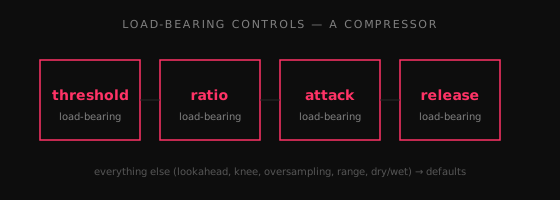
four stages here: threshold, ratio, attack, release. these are the four front-panel decisions that pass the load-bearing test on every compressor i have built. lookahead, knee width, range cap, dry/wet, output trim, sidechain HPF, all defaulted, all hidden. the heuristic that fell out of running this test on my own catalog: if a control would be touched in fewer than 1 in 10 sessions, it does not belong on the panel. the front panel is for decisions, not preferences.
what this changes
try the test on the next plugin you open. start with your favorite EQ. what does the “tilt” knob actually do that you couldn’t predict the sound of before turning it? what would you lose if it was removed? if you cannot answer in one sentence each, the knob just failed.
(the related move: when you find yourself reaching for a tooltip on a plugin, that knob also failed the test. a tooltip is the developer admitting the user can’t predict the knob’s behavior. that’s one we will come back to.)
from the studio
the new website archive at kernaudio.io/field-notes goes live with this issue. every Tuesday, one mixing or DSP idea, ~5 minute read. past issues stay searchable on the archive, that’s the structural difference between a newsletter and an inbox-only broadcast. if a friend asks you about the load-bearing test in three months, the link still works.
what is the one knob you have never touched on a plugin you’ve owned for three years? reply with the plugin and the knob. those answers become the next few issues. i read every reply.
jonas
the apartment is the size of a hallway and the catalog is built from it.
more field notes
Sep 22, 2026
·build log
three years, twenty-one versions, one reverb
open is out. a reverb that listens to what you feed it and makes room for it, three years in the making, with a blind-listening lab i did not plan to build and a rule that nothing ships until it passes. it failed twice. here is what the lab found, what i fixed, and what i heard with the names hidden. $29, no ilok, and the bundle stays $69 for five plugins through monday 5 october.
Sep 15, 2026
·sound science
your loudest master never arrives loud
streaming turns your master down to a target before anyone hears it, so mastering louder buys nothing but lost dynamics. and the loudness war mostly did not do what people think: measured across five decades the spread between loud and quiet did not narrow. what came down was the transient crack, by about a decibel and a half. so the thing to watch is heavy limiting and clipping, more than compression as an idea, and the move is to master until it is finished and let the platform set the number.
Sep 8, 2026
·sound science
the dialogue you mixed is not the dialogue they hear
a chain of reasonable decisions ends at the sofa with the voice buried. the film is about the chain. this issue is about your end of it: how to mix dialogue so it survives a stereo fold-down, a flat panel and an ordinary pair of ears, with the numbers i use, including one my own films failed on.