OPEN / plugin 06
algorithmic reverb for electronic music.
designed for synthesis and drum machines. not another plate emulation.
a reverb that hears the mix. 5 knobs. $29.
listen
hear the difference.
click play, then switch between the original and three DEPTH settings while it plays. every file is matched to the same loudness, so what changes is the reverb and nothing else. the last two pairs hold DEPTH and move BLOOM instead.
🎧 for best results, listen on headphones or studio monitors.
listen after the hit: the first reflections keep its direction, the tail sits in the room.
space: play/pause. left/right or a/b: switch.
loading audio
at 100 the dry is gone and only the room is left. the word is still there in the tail.
space: play/pause. left/right or a/b: switch.
loading audio
the tail connects the chords. at 25 it is behind the pad, at 100 it is the pad.
space: play/pause. left/right or a/b: switch.
loading audio
listen into the gaps between phrases. that is where a hall earns its length.
space: play/pause. left/right or a/b: switch.
loading audio
the bed keeps going under the phrase. the next note arrives into it and the bed does not flinch.
space: play/pause. left/right or a/b: switch.
loading audio
a short note, a long bed. at 100 the pluck is only the thing that starts it.
space: play/pause. left/right or a/b: switch.
loading audio
same depth, same length. at 10 the loud bands decay sooner and the tail steps out of the way of the pad. at 90 they ring longer and the tail takes on the pad's own colour.
space: play/pause. left/right or a/b: switch.
loading audio
the carve, heard on one note. 10 keeps the bed under the pluck; 90 lets the pluck's spectrum sustain as a drone.
space: play/pause. left/right or a/b: switch.
loading audio
the idea
one knob, two opposite reverbs.
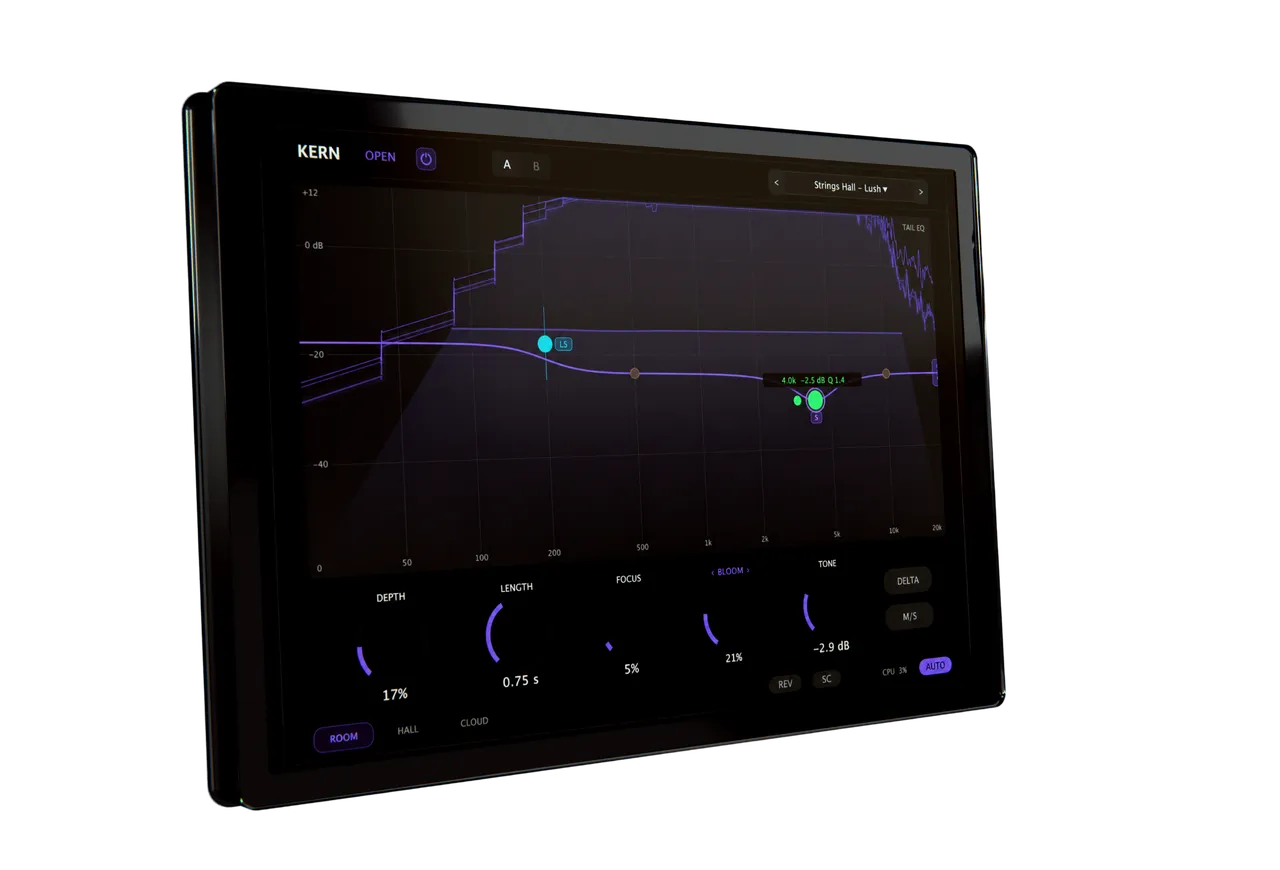
OPEN analyses your dry signal across 40 ERB bands and shapes the reverb tail band by band. what it does with that analysis is a single continuous control: BLOOM.
invisible
at low BLOOM the loud bands get shorter reverb. the tail carves itself out of the way of the source, so the reverb adds depth without masking the mix. no decay-EQ, no ducker to set up.
exposed
at high BLOOM the same analysis runs in reverse. loud bands get long reverb, sustaining the source’s spectral signature as a dark wash. at the top the tail is effectively infinite: the source becomes the ambience.
at the centre of the range OPEN is a flat, classical reverb with no spectral awareness. a reference point, not the default.
new to reverb, or want the theory behind the idea? the reverb guides start from zero.
the characters
three spaces to reach for.
each character re-voices the whole engine: diffusion, damping, modulation, and tone, not just the decay time. switch with one click.
ROOM
a bright, short space. tight diffusion, quick decay, a lifted top end. air around a sound without washing it out.
the shortest of the three. a slight low-frequency roll and an open top, for width and depth on drums, keys, and plucks.
HALL
natural-hall absorption. a longer tail with the high end rolling off the way a real room eats it. the classical reverb of the three.
warm low band, gentle high-frequency damping, a decay that keeps its shape. the one for pads, vocals, and sustained material.
CLOUD
a dark, drifting drone. heavy diffusion, low-frequency weight, slow modulation. the tail that becomes an instrument.
push BLOOM up and CLOUD turns into an effectively infinite pad built from whatever you feed it. the source becomes the ambience.
the controls
five knobs. no menus.
the whole reverb on the surface, the KERN way. no pages, no hidden racks.
DEPTH
how much reverb. the wet balance against your dry signal.
LENGTH
decay time. from a short slap to an effectively infinite tail as you reach the top of the range.
FOCUS
how hard OPEN reacts to the mix. up follows the source more aggressively; down for a static, classical response.
BLOOM
the character axis. from invisible (the reverb carves itself out of the way of the source) through flat, out to exposed (the source’s own spectrum sustained as a drone).
TONE
a tilt across the whole tail. darker to the left, brighter to the right. gentle, for sitting the reverb in the track.
features
what makes OPEN different.
01 / it listens to the dry signal
OPEN analyses your source across 40 ERB bands and shapes the tail per band. loud bands get shorter reverb, so the reverb ducks out of the way of the source instead of masking it. no manual decay-EQ, no ducker to dial in.
02 / invisible to exposed on one knob
BLOOM morphs continuously from a mix-aware reverb that sits under the source, through a flat classical reverb at the centre, out to an infinite drone built from the source's own spectrum. one control, two opposite reverbs.
03 / three characters
ROOM for a bright, short space. HALL for natural-hall absorption. CLOUD for a dark, drifting drone. each one re-voices the whole engine, not just the decay time.
04 / built for electronic sources
tuned on synths and drum machines, not sampled concert halls. the diffusion and modulation are set so pads bloom and drums keep their transients where plate emulations smear.
05 / no iLok. lifetime license.
offline forever, no account, no subscription. mac and windows together. the same terms as every KERN plugin.
specifications
the numbers.
Field Notes from KERN Audio.
6,000+ producers reading. weekly Tuesday email + new plugin announcements.
one mixing or DSP idea per issue. ~5 minute read. no spam, easy unsub.
check your inbox and click the link to confirm.
no spam. unsubscribe anytime. opens and clicks are counted, details.
what people are saying