The sound that hides another
Your ear hears in bands. That is why a bass can swallow a guitar that is perfectly audible on its own, and why a mix can get louder without getting any hotter. Five things to try with it in your next session, and a call for a few duos to test SYNC.
Here’s a number I keep coming back to. Play a 1 kHz tone at 60 dB, then add a second tone at 1.5 kHz, 35 dB. The second one is just gone. On its own you’d hear it fine. Next to the first one, it disappears.
That’s how hearing works, and once you know it you start hearing it in every mix.
The ear listens in bands
Your inner ear sorts what comes in into bands, and inside a band, sounds compete. It’s a trade: broad bands let the ear react fast, and you pay for that with a bit of frequency detail.
How WIDE is a band? About the same up to around 500 Hz, then wider as you go up, roughly a third of an octave over most of what you hear. And they move with the music, forming around whatever you’re listening to right now.
Every KERN plugin listens this way too, in 40 bands spaced like the ear’s own. SMOOTH, for example, decides what’s harsh band by band, the way your ear does, instead of one frequency line at a time.
Three things the bands do to your mix
Loud things hide quiet things nearby. Two parts in the same band fight, and the louder one wins. The quieter one is still on the meter. You just can’t hear it.
Masking spreads upward. A loud sound hides what sits above it more than what sits below it. Turn the loud one up by 1 dB and the stuff above it can need about 3 dB more to stay audible (up to 6 for some people). So a big bass reaches up into the low mids too, and the harder you push it, the further it reaches.
It hangs around after the hit. Masking can last 100 to 200 ms after the loud sound stops. A ghost note right after a big kick can be there on paper and nowhere in your ears.
what to try in your next session
Solo things in pairs. A part that sounds great soloed and vanishes in the mix is usually sharing a band with something louder. Solo the two together and move one of them (a small cut on one, a small boost on the other, or a different octave) until both read.
Check the low mids every time you turn up the bass. The bass knob is also a low-mid knob, because masking spreads upward. After a bass boost, listen to the guitars and the lower half of the vocal as well as the low end.
Give quiet details room after loud hits. If something important sits right after a kick or snare, a short duck on the loud part, or a few milliseconds of space, can bring it back. That 100 to 200 ms window is what you’re working with.
Spread energy to sound louder. Keep the total energy the same, and a sound centred at 1 kHz starts getting louder once it spreads wider than about 160 Hz. The ear adds up loudness across bands, so a mix that covers more of them can sound bigger at the same level. Try that before reaching for another limiter.
Judge masking at the level you’ll mix at. Masking grows with level, so a balance you set loud can fall apart quiet, and the other way round. Check the clash at your normal listening level before you trust the fix.
if you want to go deeper on this, i can deffo recommend Musimathics by Gareth Loy (volume 1, the hearing chapters). Most of the numbers in this issue come from there.
SYNC: looking for a few duos
SYNC is the thing i mentioned last week. Two producers, one Live set, each in your own studio. You both keep working in your own Live, and when one of you saves, your changes go to the other.
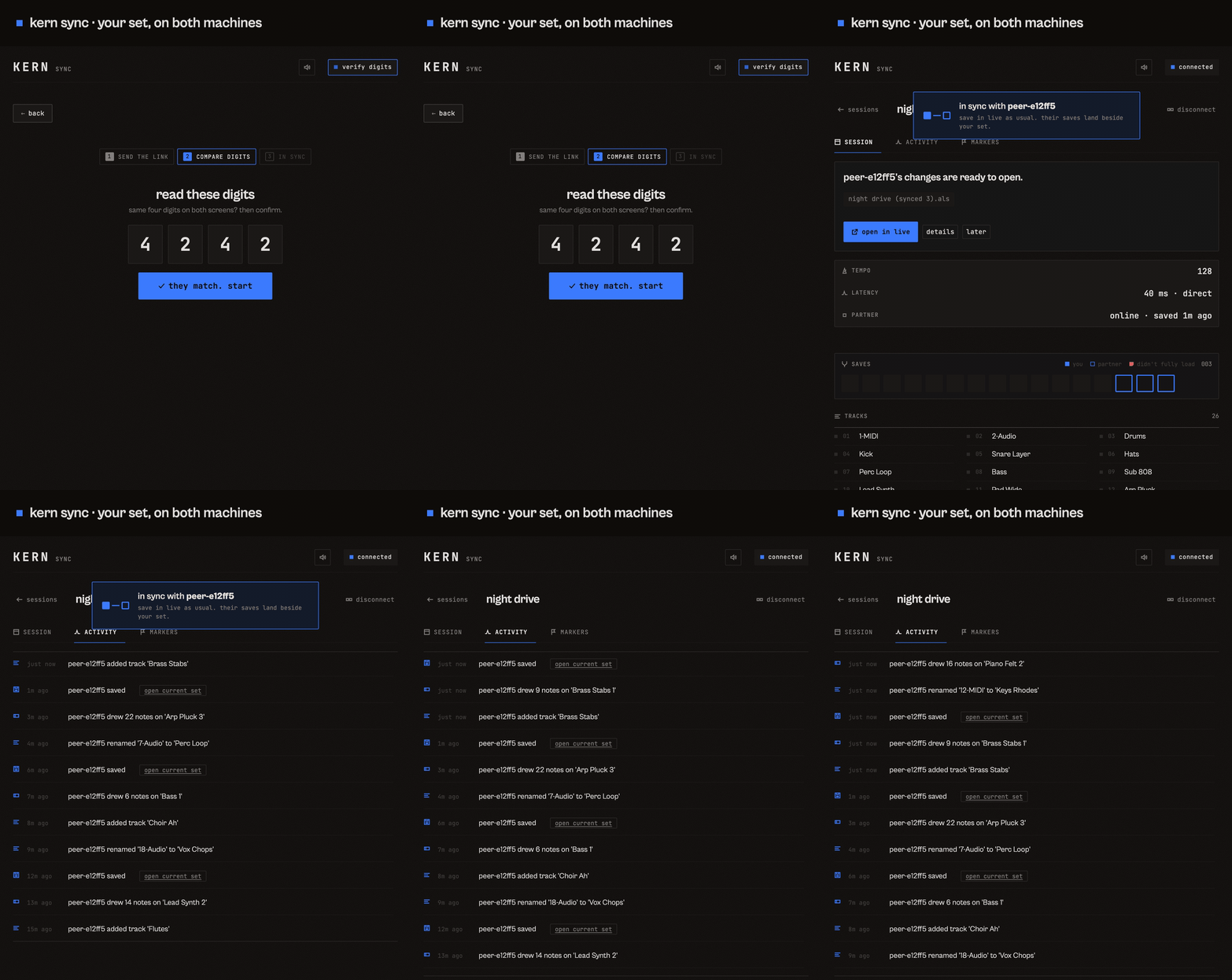
the alpha build, with sample data. Your partner’s save lands as a new copy next to your set, and the file you have open stays untouched.
it’s an early alpha, and testing starts in the next few weeks. I’m looking for three to five pairs to try it with me (and to break it, mostly).
what you’d need:
- Ableton Live 12, both of you. Mac or windows, any mix.
- someone you actually make music with. No partner right now? Reply anyway, i can be the other machine.
- some patience. Things will break, and when they do i’ll want to hear what you did right before.
from the studio
still in the lab most days, mostly on the big update for the four. The bands are a big part of that work, so this one was on my mind anyway. There’s a danish saying, mange bække små gør en stor å (many small streams make a big river), and the loudness trick above is that saying in physics: the ear adds up what each band hears.
Two things you can reply with this week: the part of your mix that always seems to disappear when everything comes in, or just SYNC if you want in on the test. I read all of them.
-Jonas
more field notes
-
oct 13, 2026 · sound science
Take apart the sound you love
A thank you, a look at where I spend my days right now, and the oldest learning trick I know: take apart the mix or the plugin you love, rebuild it from memory, then find out where you were wrong. Plus five small bits of maths for your next session.
-
oct 6, 2026 · sound science
The guitars that vanished on a phone speaker
A CHECK user asked a question I could not answer with a meter. Why a mix can look fine on your meters and still lose something in mono, and how to tell the normal kind of loss from the kind worth fixing.
-
sep 29, 2026 · sound science
OPEN a week in, and what comes next
OPEN is a week old, the other four plugins are headed for one big update through the same blind test, and this week's film is about a music study nobody has run twice. A result counts once someone runs it again.