three years, twenty-one versions, one reverb
open is out. a reverb that listens to what you feed it and makes room for it, three years in the making, with a blind-listening lab i did not plan to build and a rule that nothing ships until it passes. it failed twice. here is what the lab found, what i fixed, and what i heard with the names hidden. $29, no ilok, and the bundle stays $69 for five plugins through monday 5 october.
i kept hearing the space move after the note had stopped. that is the sentence in my notes from 17 september, on the day the reverb i had been working toward for three years failed its own listening test for the second time. open is out today, and the story of how it got here is mostly the story of that sentence.
three years
i stopped touring in 2023 and started learning c++ and dsp to build the tools i wished existed. a reverb was on the list from the first day, and it went last because it was the hardest. smooth shipped in late 2024, then warm, wide and push. the first research note for open is from this april: a reverb that listens to what you feed it, so the tail makes room for the dry signal instead of sitting on top of it. the first line of code is from 28 april. between then and this morning there were twenty-one numbered versions, a small beta in july, and a lab i did not plan to build.
the frame
a reverb is mostly heard where nothing is playing. the tail sits somewhere in the stereo field, it holds or it moves, and when the next note arrives it either stays a bed or it jumps. every decision in open comes back to that gap between the notes.
the structure underneath is not mine. the late tail is a feedback delay network, the design most algorithmic reverbs share, and two of its parts come from papers: attenuation per delay line so decay can differ by frequency (schlecht and habets, 2018), and a feedback matrix chosen to add as little colour of its own as the maths allows (dal santo, prawda, schlecht and välimäki, 2025). what i built on top is the listening. open measures the dry signal across forty perceptual bands and changes the decay time band by band. focus sets how much the source is allowed to shape the tail. bloom sets which way: below half, the loud bands decay sooner and the tail steps out of their way; above half, they ring longer. that is the whole idea. five knobs, and the tail shapes itself around what you play.
the lab i did not plan to build
by late august i had a reverb that measured well and sounded slightly metallic, and i could not say why. so on 4 september i built a listening room out of scripts: ten sources, the same decay on every reverb, level matched, names hidden, and a page where i pick a best and a worst per source and a database keeps the score. the other reverbs in the room are three from valhalla that i own and still use.
the first session read zero best picks and nine worst. eight builds and nine sessions later, the same night, it read five best and zero worst. the number the lab tracks alongside the picks is called coloration, and over those builds it went from 0.251 to 0.037. that is the closest i can come to a number for “metallic”.
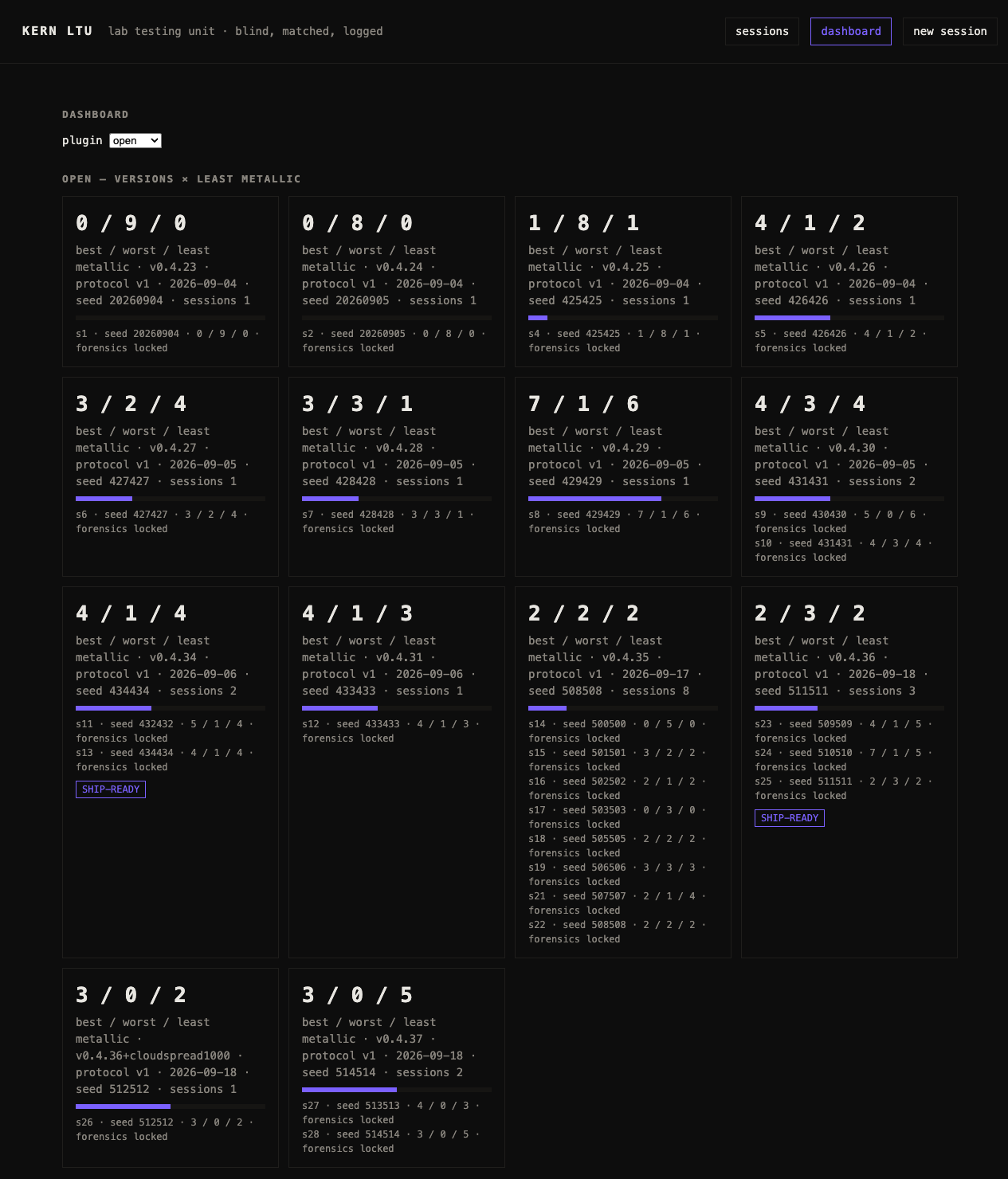
then i made a rule: nothing ships until it passes the blind test. open failed it twice in september, once on how the stereo image was fed into the tail and once on cloud’s bed, and both fixes went back through the same test before this release.
twenty-seven sessions, 233 sources judged, one listener. in the final four sessions, on the build that ships, open came out ahead of reverbs i paid for and still reach for. it is the first time i could say that without knowing which was which.
three ways to leave space
room is for percussion and anything close. a nearby space around the hit. start short, then listen after a panned hit: the first reflections keep its direction, and the tail sits in the room instead of following it.
hall is for chords and slower phrases. a longer space that connects notes. leave gaps in the playing and listen through them, that is where a hall earns its length.
cloud is for guitar and pads. a bed that keeps going under the phrase. listen as the next note enters. it should arrive into the bed, and the bed should not flinch.
what this changes
download the free demo and put it on a mix you are still working on. a panned percussion hit for room. a sustained chord with gaps for hall. a phrase with silence in it for cloud. listen past the fade, into the next onset.
the offer
open is $29. the bundle is now five plugins: smooth, warm, wide, push and open. through monday 5 october it stays at the four-plugin price, $69, then it goes to $79 list. if you already own the bundle, open is included at no extra cost: re-download from your existing order and your key covers it.
hear open and download the free demo
from the studio
three years to get to this plugin, and the last three weeks were the lab. it is set up for the other four now. if you put open on something today, reply and tell me what you put it on. i collect these.
jonas
more field notes
May 19, 2026
·build log
the tooltip I deleted
Tuesday night I added a tooltip to clarify a knob. Wednesday morning I deleted both. here is the rule the tooltip broke.
Sep 15, 2026
·sound science
your loudest master never arrives loud
streaming turns your master down to a target before anyone hears it, so mastering louder buys nothing but lost dynamics. and the loudness war mostly did not do what people think: measured across five decades the spread between loud and quiet did not narrow. what came down was the transient crack, by about a decibel and a half. so the thing to watch is heavy limiting and clipping, more than compression as an idea, and the move is to master until it is finished and let the platform set the number.
Sep 8, 2026
·sound science
the dialogue you mixed is not the dialogue they hear
a chain of reasonable decisions ends at the sofa with the voice buried. the film is about the chain. this issue is about your end of it: how to mix dialogue so it survives a stereo fold-down, a flat panel and an ordinary pair of ears, with the numbers i use, including one my own films failed on.