why your widener kills your snare
a wider mix and a softer snare are the same move. width is decorrelation, and decorrelation is the natural enemy of a sharp transient and a safe mono fold. here is the trade, and the three rules that get you the size without the cost.
a producer sends me a mix and asks why his drums feel small. the kick and snare hit fine in his room, he says, but next to a commercial reference they sound weak. i ask what is on the drum bus. a stereo widener, pushed to about 70%, “to make it sound big.” that is the culprit. the widener made the mix wider and the snare softer in the same move, and he could not hear the trade, because widening hides its own cost.
the frame
width is not volume and it isn’t panning. width is decorrelation: making the left and right channels carry slightly different versions of the same sound. your brain reads “different in each ear” as “spacious,” so decorrelation feels wide. the problem is what it does to two things you also care about: transients and mono.
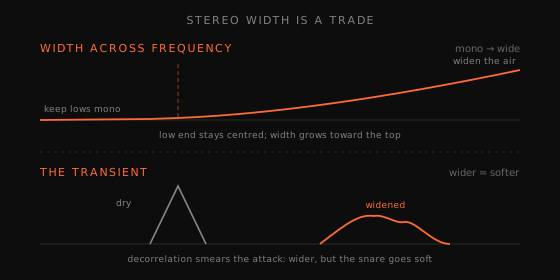
a transient is a moment where left and right are supposed to be nearly identical, one sharp aligned spike. decorrelation works by smearing the phase relationship between the channels, and a smeared transient is a softer transient. the snare stops being one crisp event and becomes two slightly different events your ear blurs together. it sounds wider. it also sounds weaker. that’s the trade, and most wideners never show it to you.
the second cost is mono. when a club rig, a phone speaker, or a bluetooth speaker sums your mix to mono, anything you widened with phase tricks can partially cancel. the harder you pushed, the more low end and body can vanish on fold-down. you mixed it wide on headphones; it plays thin on the thing most people actually listen on.
the fix the research keeps landing on
here is the useful part. when people actually study stereo widening, they converge on the same handful of rules every time. Orchisama Das published an open-source widener at the DAFx conference in 2024 that’s a clean example: it decorrelates with allpass filters, splits the signal into low and high bands, and then deliberately steps out of the way during transients. three rules fall out of that:
widen the sustain, not the transient. good wideners detect the onset and back the widening off during the attack, then let it back in on the tail. the snare stays sharp; the cymbal wash stays wide. you get the size without the mush.
keep the low end mono. widen the air and the reverb, leave the bass and kick centred. low frequencies are where mono cancellation does the most damage, and they carry almost no spatial information anyway. a hard mono-below crossover, usually somewhere around 150 to 300 Hz, is the single highest-value setting on any widener.
watch the correlation, not just the width knob. a correlation meter tells you how close to cancellation you are. while it stays positive, you fold down safely. push it negative and you have mixed a mono-collapse bug straight into your master.
(this is exactly how i built WIDE: it widens per frequency band, protects transients with onset detection, and folds the lows to mono below a movable crossover. i did not invent those rules. the research did. i just refused to ship a widener that ignored them.)
what this changes
next time you reach for a widener, do three things. set a mono-below crossover so your low end stays centred. find the transient-protect control and turn it on, or if there isn’t one, simply use less width on anything percussive. and hit the mono button before you commit, every single time. if the snare collapses or the low end disappears, you widened too far.
the free tool for that third step: CHECK, my mono-compatibility analyzer, shows you exactly what drops out when your mix folds to mono, in real time, for nothing. the point of this issue isn’t to sell you a widener. it is to make sure the one you already own isn’t quietly costing you your drums.
from the studio
this one came straight out of the inbox. last week’s piece on upward compression pulled a wave of replies naming tools, OTT, Waves MV2, the usual suspects, and a few of you pushed back in ways that became this week’s reading. the sharpest correction came from a composer who has been hunting resonances by hand for forty years. keep them coming. the replies are the actual newsletter; i just write the first draft.
what is the widest you’ve ever pushed a mix before it fell apart in mono? reply, i collect these.
jonas
more field notes
Sep 15, 2026
·sound science
your loudest master never arrives loud
streaming turns your master down to a target before anyone hears it, so mastering louder buys nothing but lost dynamics. and the loudness war mostly did not do what people think: measured across five decades the spread between loud and quiet did not narrow. what came down was the transient crack, by about a decibel and a half. so the thing to watch is heavy limiting and clipping, more than compression as an idea, and the move is to master until it is finished and let the platform set the number.
Sep 8, 2026
·sound science
the dialogue you mixed is not the dialogue they hear
a chain of reasonable decisions ends at the sofa with the voice buried. the film is about the chain. this issue is about your end of it: how to mix dialogue so it survives a stereo fold-down, a flat panel and an ordinary pair of ears, with the numbers i use, including one my own films failed on.
Sep 1, 2026
·sound science
a row of spikes nobody trained in
generated music leaves a mark, and it has nothing to do with taste. it is a row of evenly spaced spikes, put there by an operation that is also sitting inside half the plugins you own. which gives you a rule you can use on any analyzer: evenly spaced peaks came from a process, musically spaced peaks came from the music. plus a second tell the paper does not cover, and a note on why neither one is worth trying to EQ.